

Cracked Teeth
Cracked teeth demonstrate many types of symptoms, including pain when chewing, temperature sensitivities, or even the release of biting pressure. It is also common for pain to come and go, making it difficult to diagnose the cause of discomfort.
Chewing can cause movement of the cracked pieces of your tooth, and the pulp within the tooth becomes irritated. At the same time, when biting pressure is released, the crack can close quickly, resulting in sharp pain. Eventually, the pulp will become damaged and tooth will consistently hurt, even when you are not chewing. It is possible that cracks can lead to infection of the pulp tissue, which can spread to the bone and gum surrounding the problematic tooth.
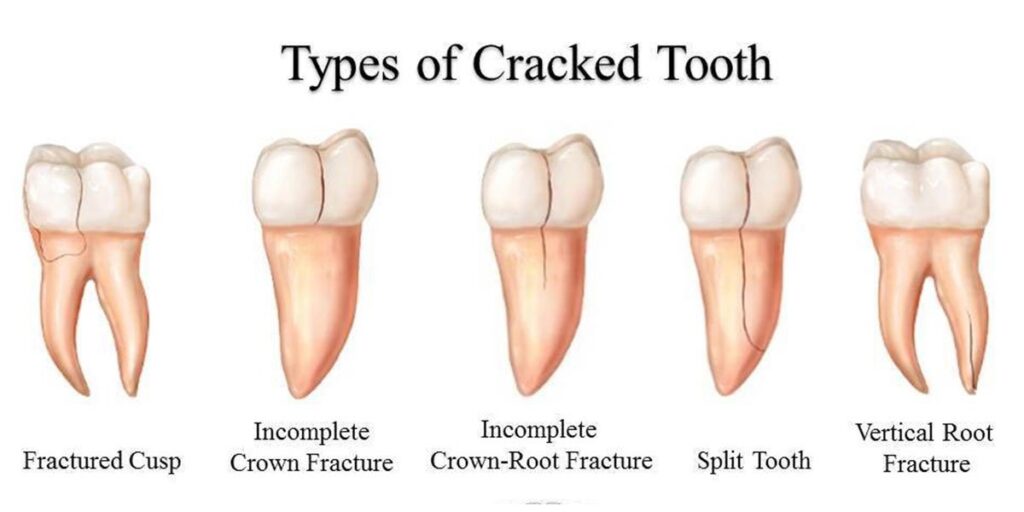
In endodontics, cracked teeth are classified into several types based on how and where the tooth is fractured, because each type has a different prognosis and treatment plan.
Here are the main types of cracked teeth recognized in dentistry:
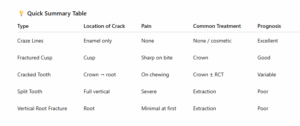
1. Craze Lines
Description: Tiny, superficial cracks in the enamel only.
Symptoms: Usually none — they don’t cause pain.
Treatment: No treatment needed unless for cosmetic reasons (e.g., polishing or veneers).
Prognosis: Excellent; not a structural or health threat.
2. Fractured Cusp
Description: A piece of the tooth’s cusp (pointed chewing surface) breaks off, often around a filling.
Symptoms: Sharp pain when biting down; sensitivity to temperature.
Treatment: Often restored with a crown; pulp is usually not involved.
Prognosis: Good once restored.
3. Cracked Tooth
Description: A crack extends from the chewing surface toward the root but does not separate the tooth into pieces.
Symptoms: Pain when chewing or releasing bite; occasional sensitivity.
Treatment: Early detection is critical — often needs a crown, and if pulp is involved, root canal treatment.
Prognosis: Variable — the deeper the crack, the worse the prognosis.
4. Split Tooth
Description: The crack has progressed to fully divide the tooth into distinct segments.
Symptoms: Similar to cracked tooth but usually more severe; segments may move independently.
Treatment: Usually extraction, though sometimes a portion can be saved with advanced surgery.
Prognosis: Poor for whole-tooth survival.
5. Vertical Root Fracture
Description: A crack begins in the root and extends toward the chewing surface.
Symptoms: Often minimal symptoms at first; may present as localized gum infection or bone loss.
Treatment: Extraction or root removal (if in multi-rooted tooth).
Prognosis: Poor — usually cannot be saved.
Periodontic
Protect your gums and teeth with expert periodontal care and gum disease treatment in Laguna Beach.
Orthodontic
Straighten your smile with clear aligners or braces from Laguna Beach’s trusted orthodontic specialist.
Endodontic
Save your natural teeth with expert, pain-free root canal therapy in Laguna Beach by Dr. Farsio.
New Dental Clinic
Now open in Laguna Beach—expert endo, ortho, and perio care from trusted dental specialists.